Tigers, Temples, and Tropes - Part 1.
Over the last several years I have spoken with lots of people in the zoo design profession about a variety of subjects. But one I wasn’t expecting to hear so frequently about, and from so many people, was a very specific type of exhibit: the Tiger Temple. The term elicited a surprising range of responses, from enthusiastic descriptions of their favorite tiger temple to the pejorative utterance of the phrase, dismissive of it as an overused trend.
Whichever side of the fence you might fall on, the tiger temple has undeniably become a prominent element of many zoos and is probably the most common thematic design trope I have encountered at zoos.
Tigers are already dynamic and popular animals, and a well done tiger temple can create an exceptional guest magnet. My kids respond incredibly well to such temple exhibits, which probably goes a long way towards explaining their continuing popularity. For all of the potential pitfalls, the trope can create an impressive backdrop for a highly engaging story that resonates with guests.
This is going to be a multi-series post on the presentation and representation of tigers in contemporary zoos. Here I’ll first describe the design characteristics of the tiger temple, the different types of temples commonly found, and the stories those temples might tell about tigers, nature, humans, and our interconnected place on this planet. Later on, I’ll share some examples of this design phenomenon that I have encountered to explore the nuances of this trope. Lastly, I’ll discuss the other ways that tigers are often presented in zoos and wrap this all up with a typology of tiger exhibits (that should be some fun design esotericism).
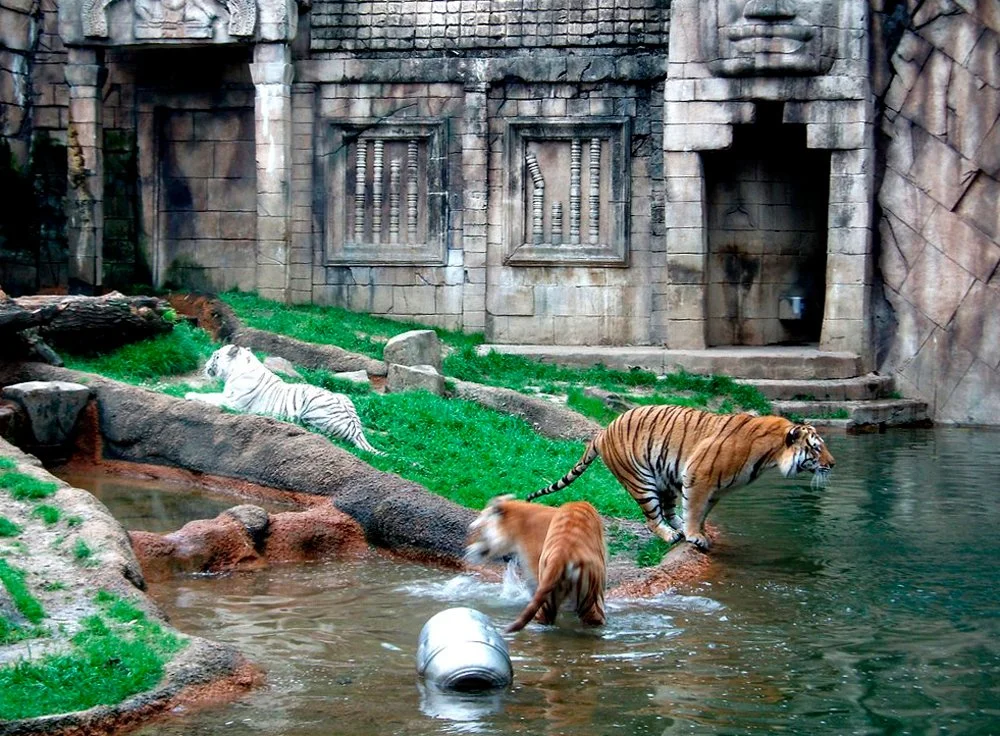
As the name suggests, the tiger temple is an exhibit where a tiger is presented to the guest in a setting dominated by an architectural set piece resembling a temple. If you’ve been to a zoo in the last twenty years or so there is a good chance you have encountered this enclosure type. Normally it’s a temple, though it might also occur as a palace or fort. The temple might be ancient or modern; more frequently the former. Sometimes it is clearly tied to a region, typically the native habitat of the specific tiger species on display. Other times the styling is much more general—a generic jungle theme; something we might expect Lara Croft from Tomb Raider to be exploring. In nearly all of these exhibits it appears that humans have abandoned the site some time before. The structure is collapsing and nature is encroaching on former human habitation. Along with nature moving in, so has the tiger.
Greenslaw/Flickr
The first contemporary tiger temple that I found was the one at Cat Country in the Memphis Zoo. It was designed by Torre Design Consortium, a multi-disciplinary New Orleans design firm that has built up a large portfolio of zoo design work. Presaging what was to come, the rockwork and faux ruins were done by Larson Company, who would go on to do the work at Disney’s Animal Kingdom (DAK) later that same decade. Cat Country opened in 1993 and was the first new major animal exhibit to open at Memphis Zoo following the ancient Egypt-themed 1990 entry plaza. Across a water moat, we look into the tiger enclosure in Cat Country with an evocative background composed of a deteriorating Cambodian temple; weathered stone, crumbling architecture, water cascading over the temple. The message is clear. Nature has retaken this ruin.
Cultural elements had started making their way back into zoos just a few years before with the opening of the Asian Elephant Forest at Woodland Park Zoo, designed by Jones & Jones. That exhibit featured some modest Thai architectural theming, but it was where Grant Jones, celebrated landscape architect and founder of Jones & Jones, coined the term cultural resonance. This provided the conceptual framework to reintroduce human cultural elements into wildlife display after a near total absence of half a century.
A few years later at Memphis Zoo this idea was taken much further. And it made a splash. The exhibit was hugely popular and even Landscape Architecture Magazine, not a place that normally pays much attention to zoo design, highlighted the project. The article described the exhibit as the ruins of Angkor Wat, but the design is clearly an amalgam that draws on many ruins from Cambodia, most notably Ta Prohm and Bayon. This is the very same kind of cultural melange that Dave found at the Mandalay Bay Shark Reef Aquarium.
The tiger temple has since expanded to zoos all over the world, with many different takes on the concept. Some settings are grand, with impeccable detailing executed to the highest level, and some are more modestly designed and constructed.
Although these enclosures are commonly referred to as a tiger temple, the trope can actually take the form of several different types of structures. The important thing is that the site represents a building that is revered in some way, typically a religious structure like a temple or shrine. The tigers have moved into where monks used to reside. The implication is that the tiger is sacred and deserving of the same reverence as a religious figure.
Tiger temples can also be secular. Sometimes the tigers reside in the palace of a former king, perhaps a royal hunting lodge like at Animal Kingdom’s Maharajah Jungle Trek, or still others are a long abandoned fort. The message for guests is that nature’s largest cats should be held in respect and admiration like a great ruler from the past. Tiger temples make tigers appear regal.
How well maintained the structure is also varies. Some tiger temples look as if all the people left just yesterday and the tigers immediately moved in. The structure is immaculate and clean. The paint is fresh, the carvings crisp, and the building is structurally sound. As we sometimes find cultural artifacts still present, perhaps the tigers are sharing the space with people. This sends an interesting cohabitation message of conflict. How else would tigers be expected to be found in this type of setting? In this version, the tiger temple almost always comprises the guest viewing areas; it is what we call a guest habitat. And the tigers lurk just outside.
More commonly the structure is in a state of disrepair. The buildings in this scenario suggests the passage of time from when humans left the site. They are crumbling and weathered. The plantings have overgrown the walls, and much of the structure appears to be buried and hidden, waiting for discovery from an intrepid jungle explorer or, in a pinch, a zoo guest. In this iteration, it is very common for elements of the ruined temple to extend into the tiger enclosure, and connect with the guest areas.
In our book, Kingdoms of Artifice, Dave and I describe a taxonomy of themed zoo exhibits. Nearly all tiger temples fall into our evocative category. These spaces evoke a strong sense of place, but don’t go far enough in facilitating a suspension of disbelief. In these types of exhibits things are a little too on the nose. It’s too obvious. These spaces aren’t very credible. While I think they’re fun and my kids find them very engaging, it still feels like I am at a zoo.
This raises the subject of verisimilitude. How realistic and accurate to a place is the representation we are seeing? When we spoke with retired Disney Imagineer Joe Rohde, who was the creative lead for the Animal Kingdom project, he called these “salient details.” From Kingdoms of Artifice:
Joe Rohde calls DAK “a make-believe documentary, not a make-believe fantasy.” He finds the entire argument specious. “As a critic, what exactly are you critiquing here? I don’t like the word authentic. It’s not authentic. It’s artificial. But I do think it is accurate to the salient details [the park] seeks to represent.”
Some tiger temples clearly tell guests where they are by faithfully reproducing these details. Such exhibits succeed in transporting us somewhere beyond the zoo, but they are few and far between. More commonly the tiger temple falls into our evocative category. We can look at two examples of this side-by-side by comparing the Siberian tiger enclosure at Pairi Daiza, an adventure zoo in Belgium, with a deeper examination of Cat Country’s tiger temple.
Pairi Daiza’s enclosure was built on a scale where all of the stylistic elements could be presented in their fullness. I find the bas-relief depicting the churning of the milk sea creation story depicted in a long hallway in near perfect recreation to the original I encountered several years earlier in Siem Reap.
A tower, adorned with faces, nearly approximates in both scale and representation the actual faced-temple of Bayon.
And the interior courtyards that the tigers inhabit are built at a scale that is believable. I’ve been to Cambodia and explored these ruins, and I could be forgiven if I believed I was visiting again.
Brad Coy
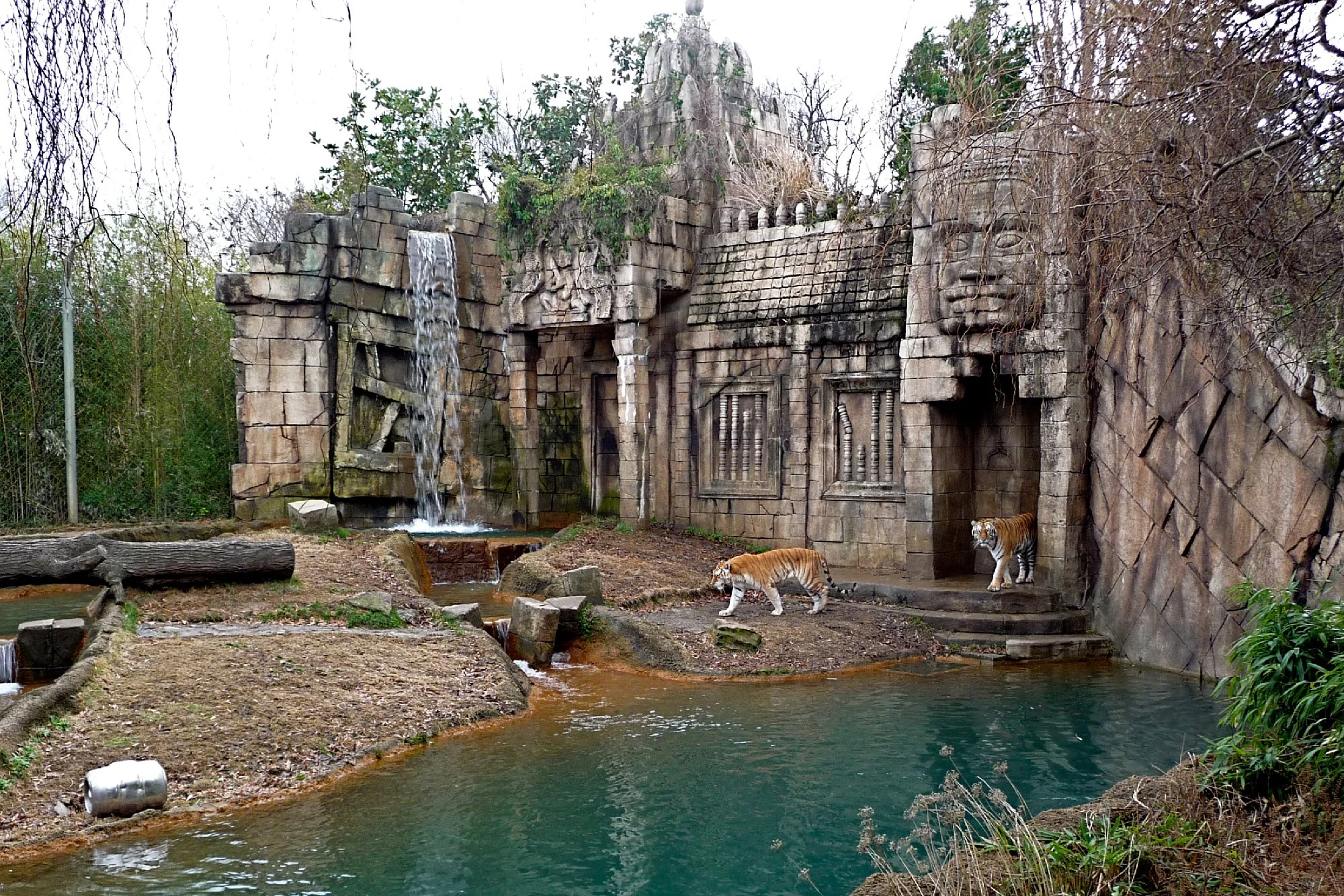
Cat Country has no pretenses about fooling you into thinking you are actually in Southeast Asia. This is established at the start when you pass through a red torii gate, a common trope used for anything Asian, despite being Japanese. This tendency to combine elements extends to the tiger temple itself, which feels like a blend of every possible Khmer architectural motif. This is an exaggerated set piece that is more Broadway stage than Angkor Wat. And that’s not bad; this isn’t a quality judgement. It’s a stylistic choice.
Disney’s own version, however, is exemplar. Unrivaled in its design context and details, this temple is actually an old hunting lodge for bygone Mughal kings. The architecture throughout the guest areas comports perfectly with what we might expect from a royal Indian estate. The walls are decaying and, in so doing, reveal the actual construction of the palace. As plaster breaks and falls away we see the bones of brick and wood. Scalloped archways frame views into garden courtyards that double as the tiger enclosures. Ornate frescos are depicted on themed, sculpted surfaces which the Disney Imagineers call character plaster. The artwork is highly authentic to its time and place. Below us are cracked pavers or concrete made to look like dirt. This is theming in totality. Probably the ultimate tiger temple, for now.
At some other zoos there is little attempt to re-create reality. The designers tried to conjure a feeling, or atmosphere, but it is nowhere in particular. For instance, the tiger temple at Lisbon Zoo is a tumbledown ruin with ambivalent architectural styling that suggests little. We could conceivably be in India, Southeast Asia, or even Mesoamerica. Somewhere tropical inhabited by an ancient civilization. The site gives off lost city vibes, like Dave found at the Shark Reef Aquarium. Atop the gateway to the temple a tiger statue stares down at us, a somewhat comical place marker that feels a little too exact.
Why are there so many tiger temples…and why temples in the first place? I think there are several reasons why this type of theming is deployed. First and foremost, people like it. The best tiger temples, like at DAK, feel transportive. They place us where the tiger lives, this is especially effective for designs with high levels of verisimilitude. It feels exotic and adventurous and takes you out of the humdrum steel and glass cages and endless cookie-cutter homes that define most of our urban environments.
A good tiger temple can ground you in a place and make it feel like you have stumbled upon a site that has always been here. That the tiger has always been here. Going into one of these exhibits creates excitement for guests. It’s unfamiliar and we are free to discover, imagining ourselves as an explorer for National Geographic or cosplaying as Indiana Jones.
While visiting countless tiger temples, I’ve observed that young people respond especially well to them. The theming is an easy way to telegraph a message and a meaning, to embed and contextualize educational content and make it feel less like we are being talked at by the interpretive material. Tiger temples provide avenues to tell cultural stories and provide a seamless opportunity to educate and connect the guest with the tiger and the local people who live in daily contact with these big cats.
There are several common stories, messages, and themes that I’ve seen in these exhibits. As I mentioned above, implicit with putting the tiger in a temple is a message of reverence or respect. The cat stalks the passages where priests and kings once strolled. We should respect the tiger in the same way that past societies revered their leaders. They also suggest the impermanence of society and the resiliency of nature. In some ways, this is a melancholic notion of hope and humility for all of us. And of course, a major reason there are so many tiger temples is because zoo designers, and the zoo directors they serve, like to copy each other. It’s a tale as old as time in design. Any model shown to be popular and effective is bound to be copied. It’s the ultimate compliment to the tiger temple that there are so many of them. They work.
Mandalay Bay’s Shark Reef
This past May I delivered a few talks at the 2026 University & College Designers Association (UCDA) Education Summit in Las Vegas, so I took the opportunity to visit the only AZA-accredited site in Nevada, the Shark Reef Aquarium at the Mandalay Bay Resort and Casino. I had been once before, back in 2008, but it was a quick stop, and I only took a handful of mostly blurry photos. Most importantly, I did not yet have zoos on the brain.
This time I wanted to document the experience from the perspective of our new book, specifically through the lens of the section on staging through filmic grammar and how framing, pacing, and transitions are established and leveraged by designers.
It wouldn’t be the Las Vegas Strip without some neon, right? This is the first indication you see within the resort that the aquarium is up ahead.
Mandalay Bay is quite proud of the fact that it is fully accredited by AZA, and there is a very large sign to prove it. I imagine the resort is mindful of animal welfare, especially after Roy Horn of the Siegfried and Roy duo was mauled by a 400-pound white tiger on stage at the Mirage in October 2003. In fact, the institution received AZA’s stamp of approval just over six months before that incident.
The Shark Reef Aquarium opened on June 20, 2000 at a cost of some $40 million with creative consultation from the Vancouver Aquarium. Global engineering firm NV5 provided the electrical and mechanical design. About 900,000 people visit every year. Coming as it did a bit over two years after Disney’s Animal Kingdom debuted, the park’s design influence is acutely felt at each and every turn. Where the attraction really excels is in its dramatic and varied pacing. This processional begins by traveling upward via escalator, stairs, or elevator. Immediately I have left the environs of the hotel casino floor and am enveloped in themed stone walls. It appears to be some kind of ancient temple.
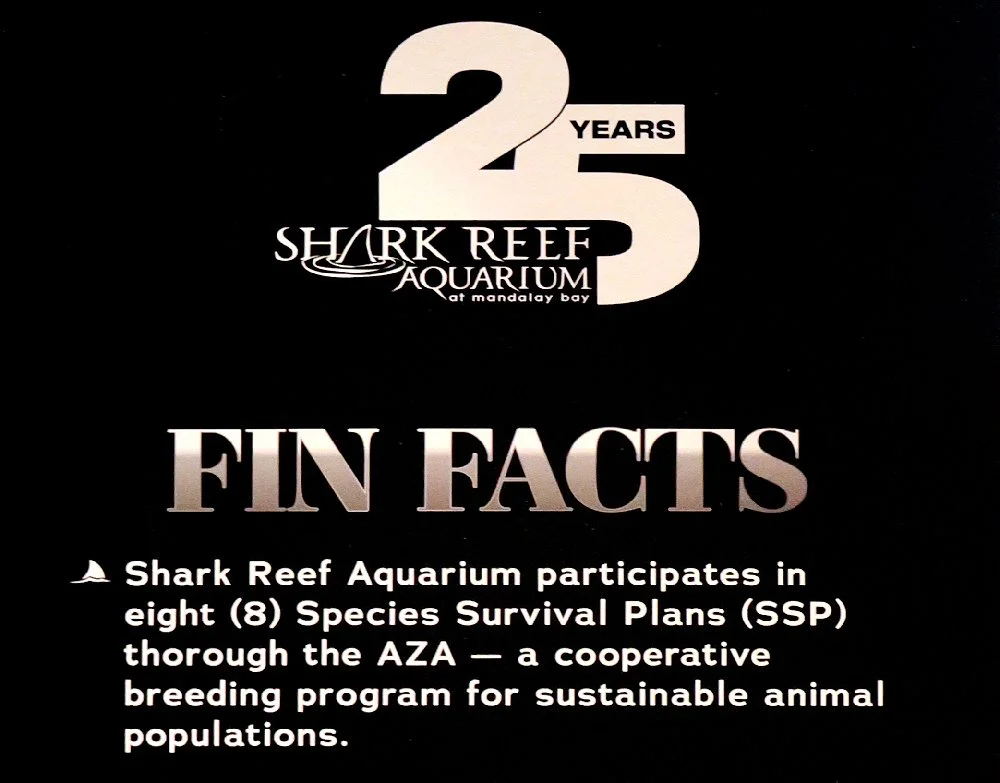
In the lobby space above where I purchase my ticket, there are multiple signs celebrating the aquarium’s twenty-fifth anniversary from last year. In addition to noting participation in eight AZA SSP initiatives, some of the other facts listed include:
Shark Reef Aquarium holds 1.6 million total gallons of freshwater and saltwater in 14 major exhibits.
Educational field trips, tours and presentations provided for more than 300,000 school kids to date.
The aquarium mixes its own seawater and has used more than 11.7 million pounds of salt since opening.
The Water Quality Lab performs daily analyses of all the exhibits and has performed over 1.5 million tests in the last 25 years.
Neptune’s Fury — The Shipwreck Exhibit is the largest tropical shark exhibit west of the Mississippi at 1.3 million gallons.
This typography overhead is the last vestige of Mandalay Bay branding present. I am about to enter another world.
The theming is not as intricate as Disney’s (it rarely is), but there is still a level of detailed paid relative to budget and craft. The cultural motifs are mixed; I am somewhere exotic, some place non-Western, but it’s not entirely clear. Here stone blocks that appear Mesoamerican are mixed with Japanese-like stone lanterns and figure carvings which could be anything from Indian Buddhist to Mayan.
Taking a nod from Animal Kingdom’s Maharajah Jungle Trek, there are ancient-looking murals above. Though the crocodile is not Audio-Animatronic, it feels similar to what you would find on Disneyland’s Jungle Cruise. Again, all the design details are vaguely exotic and non-descript.
These sealed glass doors indicate we’re in for a shift in microclimate like at so many other indoor jungles at zoos. Once again, the AZA accreditation is noted, this time on a sticker to the left.
The graphic panels I encounter are designed with what Benjamin and I call evocative theming. The large frame here with seashells at each corner is a somewhat stylized and almost cartoonish representation that matches the faux temple walls around me. There is mixture of typography, most incongruously Carol Twombly’s Trajan which is based on Roman square capitals and thus has no earthly business being here. Perhaps they were thinking of the mythical lost continent of Atlantis with its sunken ruins? Still, that story is Greek. I think it’s just a lazy design choice.
But more pointedly, what makes this panel evocative is that it still looks like we are at an aquarium (or a zoo, or a museum). The voice and appearance of the messaging is not in-world, meaning that the supposed ancient civilization that build the temple walls around me is speaking (or later, non-native explorers). The voice is curatorial; the institution is speaking: COME EXPLORE THIS ANCIENT SUNKEN TEMPLE. There is also a quote from naturalist John Muir which seems decidedly out of place in a tropical setting.
At this point the floor begins a slow descent. Apart from the ADA-mandated railings, everything is themed. At the end of some of the hallways are flat screen displays in fax stonework frames that are running a loop of facts about the aquarium. It dawns on me that during busy times, this path becomes a queue. The plastic foliage is distracting but recedes after a while and I don’t tend to notice it.
Around the next turn I glance up and see that we’re inside a large greenhouse. The kind you find all over Europe at places like Pari Daiza (Belgium), Wildlands Adventure Zoo Emmen (The Netherlands), and Zoo Leipzig (Germany). All three Benjamin and I have declared Kingdoms of Artifice, part of the seven zoos around the world that have followed closely in Disney’s footsteps.
The elaborate stone work continues, augmented by a mix of both live plants and artificial ones. The designers are clearly playing fast and loose with cultural references. This particular visage appears Thai to me, similar to the sitting Sukhothai Buddha with his elongated earlobes, but Benjamin reminds me that it actually suggests the Bayon temple complex in Cambodia. The increasing density of the tall trees, along with the humidity, really establishes a mysterious sense of place.
As the path continues to slow downward, we begin to come across the first of many animal enclosures. I counted seven total, six of which feature freshwater. At this particular ramp I realize that all the elevation gained heading up the escalators at the start is going to get shaved off bit by bit. This is a classic Disney trick—manipulating paths to distort spatial awareness. At Animal Kingdom the reverse is used from The Oasis at the entrance, with a very gradual rise that leads to a dramatic, quicker descent which, as landscape architect John Shields told us, heightens the reveal of the massive Tree of Life.
Glancing up I notice a recurring Las Vegas casino resort trope. The painted sky ceiling can be found from the Forum Shops at Caesars Palace to the entire main floor of Paris and the indoor canals of the Venetian. It’s always amusing to see where these wall planes join and the “sky” with its clouds gets distorted. They’re not fooling anybody. But out of focus, in your peripheral vision, it kind of, sort of, works.
Coming around the bend I hear the soft rustle of the first of many water features spilling over the rockwork and temple stones. The cool air around the pool is a welcome respite from the greenhouse humidity. Throughout, I was kind of disappointed that the ADA handrails were not themed, as Benjamin discovered at the Fort Worth Zoo with its wonderful habitat designs in partnership with Dunaway Associates. There you can find rails that meet code guidelines while retaining the more natural use of wood, bamboo, leather, and rope.
However, the designers did consider the sitelines above us. I spotted more than one set of running temple ramparts that really add to the grandeur of the space. Finishing the tops of things, whether guests notice them or not, goes all the way back to the original Disneyland. I also begin to notice repeated graphic patterns; here clamshells and fish line the upper lip of the wall.
I soon discover that my friendly Buddha is actually a four-sided tower, which in retrospect definitely makes me think the designers were taking inspiration from Bayon. The overall detail is impressive. Again, it’s there whether you notice it or not.
The dense mixed use of real and fake landscaping make for a real credible jungle, especially where tall trees have been planted. They encourage you to look up, where you get a real sense of the scope of the enclosure. What’s so very Disney-like is all of this is completely concealed from the rest of the Mandalay Bay casino complex. It’s the moderate, deliberately paced journey winding through that really adds to the experience.
Soon I’m inside again, where the temple ruins serve as the backdrop for a number of wildlife habitats. Benjamin and I call this form of themed presentation a dynamic show set. The structure was clearly built by some ancient civilization. Where are all the people? The animals appear to have taken over, and the spaces abandoned. As we describe in Kingdoms of Artifice:
Dynamic show sets heighten the varied and unpredictable tensions between human settlement and the natural world. The message is that the relationship between people and wild animals is complex and impermanent, with no easy answers. Conflict is ongoing, and wildlife will find ways to encroach upon us, just as we will continue to enter their ecosystems. The presentation is dynamic.
There are elaborate relief murals along the stone walls with faded pigment. Faux mold has been applied in patches everywhere.
And here is a dynamic show set as water tank. The broken columns on the exterior are continued inside the aquarium where they lie on the floor among other bits of ruins covered in moss. The temple walls continue in as well, as if the acrylic pane is a mere illusion. Half the environment is out in the air with us and the other half underwater. This set is also an example of priming, or preparing guests for what lies ahead. First we saw pools of water. That was the first tease. Now we see an actual enclosed aquarium. We must be getting closer to the main attraction.
And the path weaves out into the greenhouse again. The designers of Shark Reef were quite adept at using the architectural technique of compression and release, meaning that through a series of successive spaces, we are out in the wide open, then in a tunnel or cavern or chamber or room, and then out in the open again. Height, volume, and overall scale are constantly varied, which makes for a more interesting trek.
More aquariums now, and this time much larger. The temple ruins continue underwater as before, at full human scale. You can see an entire archway inside made of massive stone bricks.
I found this curious. At no point had we yet come across any tropical accents which take us out of this ancient, vaguely Asian/Indian/Mesoamerican temple setting. But now we have thatch roofing more at home in a tiki bar or a beach resort. Which, to my eyes, suggests an injection here of Mandalay Bay’s overall theme.
However, there is still integration with the temple walls and these portions of thatch, bamboo, and rattan. Architecturally I find this incongruous. It’s the only part of the design so far which has detracted from the immersion of the experience. It feels “made up.”
The path veers away from the wall of “tropical” aquarium viewports and continues downward. This rough lattice of timber, bamboo, and rope overhead is similar to what we have seen at other zoos. For example, at Woodland Park in Seattle, I found them everywhere. The execution is particularly strong in the indoor portion of the Tropical Rainforest (1992) area, which was designed by The Portico Group and won AZA’s 1993 Exhibit Design Award. When bamboo and rope are prominent, I call this a shipwreck motif.
Past the gateway is a looming statue of what Benjamin tells me is a Nāga. The multiple heads are unique to the Khmer culture of Cambodia, where these statues are meant to act as protective guardians. It doesn’t look like the designer’s have done much homework here, because this nāga would have traditionally been sited on a railing or near a doorway. Instead, this one acts as a pivot point as the path loops around. Not much to guard here. Despite being used out of context, the message is clear, even to a child. Wildlife can be powerful, even dangerous. And whatever ancient peoples created this icon appear to have both feared and revered this creature.
More lattices overhead which form a threshold into the next series of spaces. For the first time I catch glimpse of some small theater spotlights. These were used to great effect by Portico at Woodland Park’s Tropical Rainforest. As the Shark Reef is open until 8pm on the day I visit, and sometimes as late as 11pm, it must be pretty cool to walk through this greenhouse environment after dark. Here the temple structure rises higher than before, probably signaling the perimeter of the greenhouse and concealing the back of house areas behind.
We continue to descend through another series of switchbacks and deeper into the temple. I can imagine this path being crowded with guests waiting in line during the aquarium’s first few opening tourist seasons.
Up and to the left sits another abstracted, buddha-like (yet more Mesoamerican) figure which appears to be pregnant. Perhaps it is a fertility statue of some kind. Again, the designers were fast and loose with anything cultural. It’s vague on purpose.
At last, I reach what appears to be the final entrance to the temple proper and a departure from the greenhouse space. I did not check every sign, but so far I have seen freshwater crocodiles, Komodo dragons, pupfish, Asian arowanas, Burmese pythons, and pig-nosed turtles.
Here is the same figure again, inside yet another underwater dynamic show set. All the tanks from here on out are saltwater. The priming here is quite effective. The jungle outside is already a distant memory. It is cold and damp all around.
Suddenly up ahead a giant portal has been punched through the stone. The carvings on this wall are the same repeated patterns of fish and clamshells as I saw on the exteriors.
Enclosed acrylic walkway tubes through water like this are not uncommon at contemporary aquariums. I remember being awed by the fictional ones show at an imagined Florida SeaWorld in JAWS 3 (1983). Indeed, The real San Diego SeaWorld has them at their Shark Encounter. The first one was installed in New Zealand in 1985.
What stands out here is the thematic design. We appear to burst through the temple wall, but once I make my way across the twenty-foot span, I notice that a wall trim follows my legs at either side. We don’t leave the temple at all.
The entire attraction, including the jungle I just passed through, is home to over 100 species. Here in the central aquarium there are many kinds of sharks but also many types of fish, rays, and octopuses.
The walkway terminates at a rectangular doorway rather than a break in the wall. The same pattern of fish and clamshells lines the trim.
We are still inside this ancient temple, and in the center is the kind of touch pool common at many aquariums and zoos.
This one, however, contains ancient pottery props in addition to the expected rays.
The stonework, roots and moss wrapping around the different enclosures are remarkably credible. Just like Disney’s Imagineers, the designers here are relying on cinematic tropes. This is the kind of environment seen in the films of Indiana Jones or Lara Croft.
The credibility continues inside each aquarium, with rocks, plants, barnacles, coral, and so on.
At the far end of this space is the hull of a ship. Here two distinct environmental themes collide in an abstract manner. Every transition thus far has been gradual and considered. Not so here. We are simply expected to move, mentally, from one to another. The temple just terminates at the edge. Yet though it’s subtle, at the left there is an attempt at “blending” the two. The wall has gained a structural trim and galleon-style sconces. The stone blocks resemble the temple behind, yet everything else along this span suggests a Spanish Caribbean town of the late 1600s to early 1700s, including the doorway to, presumably, back of house. As I walk into the ship, the tears in the planking remind of how we entered the underwater tunnel.
I feel the compression immediately. The ceiling is low. The lighting is dark. There is a very quiet looping track of effects, like the sound of a wooden ship moving back and forth. You know the kind. “Harbor sounds.” I think I heard a bell at one point. Subtle yet effective. The wood planks at my feet are real. The support beams and stack of crates in the center for sitting feel more like fiberglass treated with some form of what the Imagineers call character plaster.
What’s really innovative about the aquarium walls is how the wreck of the ship’s hull continues out into the water. This provides the illusion that the acrylic—in some places as much as eight inches thick—is not here at all. All the woodwork looks correct, though it is most likely sealed fiberglass. There are barnacles. Rusted nails. Every bit of patina feels real.
The designers really got the lighting right. I’ve talked about this before within other themed spaces. It’s another Disney innovation. The sconces are credible, and the LED candlelight softly flickers.
As with the entry tunnel, the exit path is surrounded by reefs on all sides. You definitely get your money’s worth. According to one very detailed article, inside this 1.3 million-gallon saltwater tank are (on view as of 2024) Atlantic Crevalle Jack, Blue Runner, Bowmouth Guitarfish, Galapagos Shark, Green Sawfish, Green Sea Turtle, Grey Reef Shark, Lookdown, Sand Tiger Shark, Sandbar Shark, South Seas Demoiselle, and Zebra Shark.
The second tunnel connects directly back to the temple environment. Rather than breaking through the wall, there is a thick wooden doorway in character plaster. This view is looking back into the ship. Though these spaces are clearly sequential, there is nothing stopping guests from lingering or, indeed, returning and taking the path in reverse for a different perspective.
The evocatively themed panels from the entrance are back, rendered the exact same way. We’ve left the immersivity of the jungle, the temple, and the shipwreck to once again be addressed as a museum visitor. This is the strongest conservation messaging moment at the Shark Reef Aquarium. Though we’re told that YOUR ACTIONS MATTER AND YOU CAN MAKE A POSITIVE DIFFERENCE! there is no specific call to action. No way to donate money or volunteer time. Sadly, it feels like an afterthought.
When the Mandalay Bay branded wayfinding reappears, we know we are about to return to the reality of the casino. As I make my way up the stairs back to the attraction entrance, it’s evident how far we actually descended through the jungle and temple into the shipwreck. And yet it was so gradual, so expertly paced, I didn’t even notice.
There are a few last figure carvings on the wall as I ascend, these more comical than the others. Famed zoo designer Jon Coe, whom we spoke with at length for our book, would call this cartoon immersion. He insists this is not a budgetary matter, but rather an attempt at popular appeal. “People have taken the immersion idea,” he told us, but “the artificial trees, or the artificial pagoda, or whatever it is, are pure cartoons. By cartoon, I mean they’re an abstracted exaggeration of reality.”
Like so many themed experiences, the Shark Reef ends in a gift shop. The stylized metal shark forms on the railing make it clear that the immersive environment of the temple has given way to more typical retail design. I’m made aware that a portion of the proceeds from souvenir sales are donated to conservation efforts.
The Shark Reef Aquarium at Mandalay Resort and Casino in Las Vegas, Nevada, shows many signs of the influence of Disney’s Animal Kingdom, from its pacing and framing to transitions, cultural motifs, architecture, and landscaping. The exhibit is a well conceived and executed example of what Benjamin and I call evocative theming, and an subset of which Jon Coe calls cartoon immersion. If you’re in town, it’s certainly worth the visit. Take your time, don’t rush. If you linger, especially within the shipwreck, you’ll be rewarded.
Welcome
Welcome to the start of our research blog! For more than six years, the two of us—Dr. Benjamin H. George (Associate Professor, Utah State University) and Dave Gottwald (Associate Professor, University of Idaho)—have been collaborating on papers and presentations about themed spaces. Our interest began by exploring cinematography in the landscape and how designers leverage the grammar of film editing in spatial design at the Disney parks.
At some point, we began to become more interested in zoo design and themed exhibits at contemporary zoos. Benjamin clearly remembers where it all began for him—Utah’s Hogle Zoo in Salt Lake City. Not surprising for a landscape architect, he’d been a zoo enthusiast since childhood.
Benjamin
I have always loved animals. As a child I would pour over National Geographic magazines and watch The Living Planet with David Attenborough (BBC, 1984) multiple times a year, so I was naturally drawn to zoos in my youth. In fact, I often would sit in the pews at church and—while the sermon was being given—happily draw out plans for my own zoos. These looked very much like what I saw as a kid—elephants in a circular enclosure here, monkeys climbing on structures here, lions sitting on concrete rocks over there. And paths encircled all the enclosures, ensuring that my fictional visitors could see the animals everywhere and always.
Growing up in the Bay Area, I recall going on a field trip to the San Francisco Zoo and it feeling more like a grand city park. It certainly didn’t feel exotic. I remember concrete moats with water and animals hanging out on grass and concrete floors. Other animals were behind bars or fences. At the time, that’s what I thought zoos were—places where animals were kept in a park-like setting.
I also remember a family trip to the San Diego Wild Animal Park (today the San Diego Zoo Safari Park) and the thrill of riding the Wgasa monorail and seeing the big savannah and watching giraffes and other animals roam. The park felt different, but as a ten-year-old you don’t really think deeply about why that is.
Map, eastern end of Utah’s Hogle Zoo, Salt Lake City.
When I visited Utah’s Hogle Zoo I had probably not been to a zoo in two decades. I was more mature now, I was a father with my own children, and I had a degree in landscape architecture. This visit to the zoo surprised me. Things were different. Something about the design of zoos had profoundly changed in the intervening decades.
The entrance belied this change, it was straightforward with a fairly nondescript entry plaza and the expected typical “zoo architecture.” After taking the kids for a ride on the Conservation Carousel, another oldie but goodie, however, things took a sudden and unexpected thematic turn.
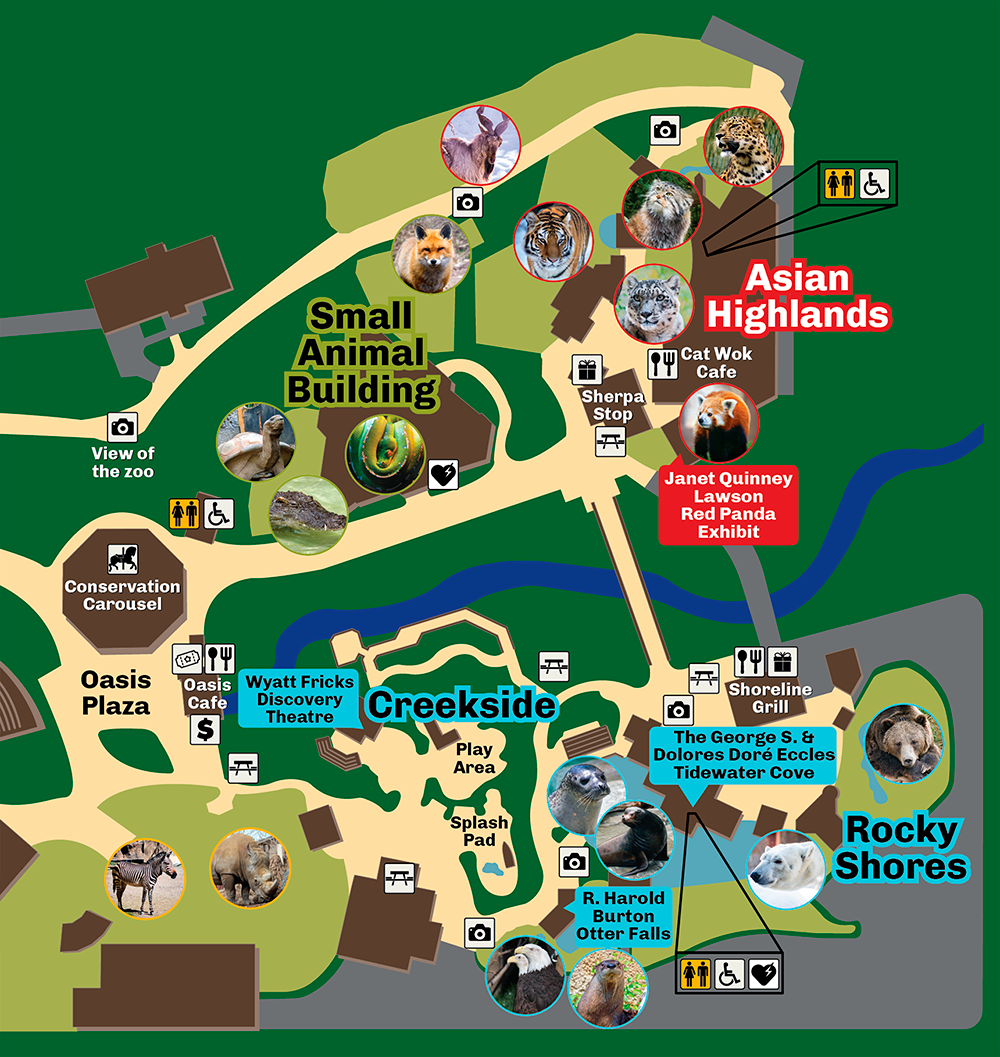
When I entered the Asian Highlands (2006) area, it seemed more like Disneyland than the zoos I remembered from my youth. The environment felt a little bit like I had walked into that park’s Adventureland, if Adventureland was in the Himalayas.
Instead of modern buildings and bars I found structures that seemed to be crumbling with time and the hallmarks of Himalayan cultures and designs. Rock cairns and haphazard retaining walls, rough hewn and irregular timber, sun-dried bricks and slate rock.
Glancing to my right, I saw lattices overhead of raw logs and leaf vines crawling up the sides of a towering roof of Chinese glazed tiles.
All around me there were crumbling walls of mixed brick styles, as if the local population had made do with whatever they could find. Everything appeared incredibly old and weathered.
Asian Highlands, Hogle Zoo, plan view. Illustration: Dave Gottwald.
I soon passed into a cluster of houses arranged around a small village square. Nothing felt like it was conceived by the hands of an architect. Things were just built, as I presume many structures would be in this part of the world.
I still noticed the requisite zoo infrastructure—wayfinding, a fire hydrant, power conduits. Still, I somehow felt transported away from Utah.
Walking deeper into the village I would encounter bridges that looked like they were meant to carry local vehicle traffic, yet this one only carried the 400 pounds of Amur Tigers.
The architecture was Asiatic and bespoke; nothing generic in sight. What had happened to the zoo of my childhood? This seemed much more theme park than wildlife park.
Everywhere there were signs of human habitation. It looked like an entire population lived here. But other than fellow zoo visitors and the animals, there were no locals to be found. It’s like everyone stopped what they were doing and had stepped away to tend to livestock or fields. Surely they would be back at any moment.
What Dave and I would later discover is that this addition to the Hogle Zoo strongly resembled the fictional village of Serka Zong at Disney’s Animal Kingdom which coincidentally opened the very same year along with the Expedition Everest - Legend of the Forbidden Mountain themed roller coaster.
Hogle had many similar details, all the way down to the weathered Nepalese prayer flags strewn overhead. Looking closer, I saw that some had writing and illustrations on them. The designers had paid attention to the details.
We had come to Asian Highlands to see one animal in particular: the Amur Tiger. At first I was afraid my children would be disappointed because we couldn’t find the tigers in the lush vegetation that filled the enclosure. Then I suddenly discovered one was, in fact, crouching right in front of me, a testament to how effective their camouflage is.
The big cat was very carefully watching a little girl nearby. He clearly saw her as a potential snack! As such, being in such close proximity served as an educational moment about the danger and strength of these wild animals.
In that moment, it really felt like a tiger was prowling outside this little Himalayan village I had wandered into. The sense of immersion was overwhelming. It was like being inside a story, inside of a narrative environment. Quite like what I’d often felt at the Disney parks. But like nothing I had ever experienced at a zoo.
By the time I had explored the adjacent Rocky Shores area just to the south, I began to suspect that Disney must have had some sort of influence on contemporary zoo design. All of this couldn’t just be a coincidence.
Having grown up in the Bay Area, Rocky Shores seemed to me a salient representation of a coastal wharf and cannery operation like I had seen on visits to Monterey. Even the dining and retail establishments all mimicked the vernacular architecture I had seen on visits to the northern California coast.
We watched seals, sea lions, and polar bears swim around and bask on rocks from within industrial buildings complete with corrugated metal siding and monitor roofs. I seemed to have left the Salt Lake City and had stepped into an early twentieth-century seaside fishing community.
Gone were the concrete moats, the flat grass enclosures and, what had been even worse, the concrete pads. But why? This experience led me to start a journey, one that Dave and I are still on with the publication of this blog.
Dave
I have vivid memories of visiting the Santa Ana Zoo on grade school trips. It was the closest to where I grew up in Southern California, about halfway between Los Angeles and San Diego. I recall it was quite small (it’s less than half the size of Hogle, about twenty acres). And I remember the same impressions that Benjamin had of the San Francisco Zoo—it was artificial with a lot of concrete.
I also visited the San Diego Zoo, San Diego Wild Animal Park, and SeaWorld on vacations with my family when I was growing up. All three seemed Disney-adjacent to my child mind, but not because of their designs. Because of their attractions. The Wild Animal park had its monorail, of course, and both SeaWorld and the San Diego Zoo still have their Von Roll aerial trams, the Bayside Skyride and Skyfari, respectively. Sadly, Disneyland lost its in 1994. You can read about all three gondolas at Werner Weiss’s wonderful Yesterland site.
Unlike Benjamin, however, it wasn’t a zoo that got me thinking about the theming of wildlife display. It was Disney’s Animal Kingdom itself. I first visited the newly opened park in January 1999 on a trip with my father and marveled at the Imagineers’ unrelenting attention to detail.
The Asia portion of the park had not yet opened. I remembered them testing the Kali River Rapids attraction which was scheduled to debut that March.
Everywhere I looked, I saw amazing architecture, props, and signage. It felt so incredibly authentic. I didn’t know it yet, but this was because the Imagineers took repeated research trips across the globe to see the people, the animals, the structures, and the landscapes of other countries.
For example, the above temple ruin, used as a Gibbon habitat, is closely based on one the design team found in Indonesia. As a result, I still think Animal Kingdom is the most intricately and elaborately themed Disney park in the United States.
When I returned in the fall of 2007 on a trip to Walt Disney World with a friend, I was actually there to document the resort’s parks for my MFA thesis project, Themerica. There was much more to see; Asia was not only open but also newly expanded. Here are the sketchbook entries from my visit:
Themerica travel journal, Animal Kingdom overview, 2007.
During these park trips, I would note my exact route on the paper map to help me recall the events of the day. I took notes on small pocket-sized notebooks that I then later collaged into spreads along with new notes and sketches.
Themerica travel journal, Expedition Everest and queue area, 2007.
I came away thinking Animal Kingdom was the coolest zoo I had ever experienced. Still, I hadn’t put two and two together yet. With my thesis project (which today lives on as the Themerica blog) I looked at theme parks, amusement parks, hotel resorts, retail, and dining from Disneyland to Dubai.
But aside from the Shark Reef Aquarium at Mandalay Bay in Las Vegas, which I visited in July 2008, I had completely ignored themed wildlife displays. Once Benjamin started visiting and documented zoos around the world during his academic sabbatical in 2021, a pattern began to emerge. Practically everyone was following in Disney’s footsteps, theming both the guest areas and the animal habitat enclosures.
Kingdoms of Artifice
The result of this investigation is our first book, Disney and the Theming of the Contemporary Zoo: Kingdoms of Artifice. The ebook PDF and hardcover are now available for pre-order from Bloomsbury Academic, Studies in Disney and Culture, and will be released September 3 and October 1, 2026, respectively.
We’re going to use this research blog to expand upon everything we couldn’t possibly include in that tome, from detailed site analysis of themed zoo exhibits worldwide to extended commentary from practitioner interviews. All augmented by copious photography. This will be a home for our musings on Disney’s tremendous influence on the zoo design profession and Animal Kingdom’s indelible and ongoing legacy within the field of wildlife display.